Saturday, December 29, 2007

Finding Friendship

Finding Forrester is the story of Jamal Wallace, a young, talented man growing up in a rough neighborhood, who finds the friendship of a reclusive famous author, William Forrester (played by Sean Connery). Jamal Wallace is influenced by misguided, yet well-intentioned friends and has tough surroundings, but is given a chance to succeed by a prestigious private school, with the unexpected help from William Forrester. This is a story of friendship, rising above life's circumstances, and second chances.

Jamal meets William Forrester by chance through a dare by his friends to break into his apartment, but ends up leaving his backpack after being chased out. William ends up reading his writing and critiques it without Jamal's permission, but intriguing him enough to go back for more critique. They begin with a mentor relationship, but a friendship begins to build. Do you know anyone in your life who has budding talent and could use a mentor to help guide them, or have you been on the receiving end of a mentor who has helped you develop your talents? Consider how Jesus started with disciples rough around the edges and turned them into some of the biggest change-agents and teachers of history. Has there been anyone in your life who has helped you spiritually? If not, would someone like that have made your life different?

When Jamal takes something that he wrote in William's apartment and turns it in for a writing contest, against William's advice and Jamal's promise, he is punished for plagiarism, since it happened to be something that William had published years ago. Instead of revealing his relationship with William, he protects him and chooses to take the punishment instead. William makes up for it in the end by coming out of his seclusion and into public to help Jamal. With this he also realizes the friendship Jamal showed to him. Have you had a friend willing to to protect you and show you love at all costs? Read Phillipians 2:1-11.

Jamal and William's lives are both changed from meeting each other. They discover what true friendship is, and with that are given a chance at redemption from their circumstances, and from their mistakes. Finding a good friend can mean all the difference in a person's life.

Sunday, November 25, 2007

Unfortunate Events Happen

In this children's book movie adaptation, the Baudelaire children become orphans and spend the next portion of their lives dealing with a series of unfortunate events, as the title suggests. They are placed with various foster families by what might be considered by us to be a sort of DHS program. The children come from an extremely wealthy family, and after first being placed with their unfit closest relative, the evil Count Olaf (played by Jim Carrey), they jump from one foster parent to another while being pursued by Olaf who is attempting to obtain their fortune.

The underlying mood of this movie is that terrible things happen to everyone, suggesting that sometimes bad people get away with doing bad things, and that good people sometimes have bad things happen to them. Many people find it hard to believe in a God that allows bad things to happen to people. Consider the idea that perhaps circumstances in our lives may or may not necessarily come from God, but how we act in them may be more important. Read the story of Job in the Bible and consider the terrible things that happened to him. He questioned God but came out with an understanding of God's power that he didn't have before.

They are first taken to their "closest relative", who turns out to only be the relative that lives the shortest distance away, and happens to be Count Olaf, who only wants the children for their money. How far removed is this from your local children's services department?

Throughout the story, the children jump from house to house, coming into contact with relatives and family friends, but relying on each other for strength, with the memory of their parents to encourage them. Some of these friends and family they learn to trust, while others they know to be untrustworthy. It takes personal experience to learn who we can trust and who we can't. Sometimes it is our family, our friends, our church, or our neighbors in either of these positions. Many people are distrustful of church because of a bad experience. For those, consider that all churches are probably not the same, and that all people are different. If we have been wronged by one group of people, there may be others out there that have been through some of the same things we have been through, including people who are different from us. From personal experiences, a church community can sometimes be closer than family or friends. Don't be afraid to try something new, or to meet new people. You may have had some unfortunate experiences, but there might be someone you meet who has been through similar events.

Sunday, October 14, 2007

Man Creates Dinosaurs...Who Is In Control?

In this fantastic film scientists have discovered how to genetically create dinosaurs using blood drawn from mosquitos encased in fossilized amber. The project is spearheaded by John Hammond (played by Richard Attenborough) and basically turned into a massive, dinosaur-filled theme park. In order to get other perspectives, he brings in a paleontologist (Dr. Grant), a botanist (Dr. Sattler), and a chaos theorist (Dr. Malcom) to take a look at the park. In the process all hell breaks loose and the makings of a great story unfold.

At first, everyone is optimistically skeptical about the potential of the park, but they grow increasingly uneasy as all their fears are confirmed. At one point, Dr. Malcolm (played by Jeff Goldblum) says, "Yeah, but your scientists were so preoccupied with whether or not they could, they didn't stop to think if they should." With the discoveries we have in modern science and medicine, does this apply to us today? Think about the medicine ads you see on television where the side effects are worse than the thing they are treating. I actually saw one that claimed to treat bipolar disorder, with side effects of coma or death.

After most of the park has failed miserably, Dr. Sattler (played by Laura Dern) finds Dr. Hammond alone thinking about what has gone wrong and how he can fix it, but she tries to get him to see the failure for what it is. It goes something like this:

Dr. Hammond: "Creation is an act of sheer will. Next time it'll be flawless."
Dr. Sattler: "It's still a flea circus. It's all an illusion."
Dr. Hammond: "When we have control—"
Dr. Sattler: "You never had control — that's the illusion!"

How often do we think that by our own will we can fix our problems, mend our wounds, right our wrongs, and turn around our failures? I like what Jeff Goldblum's character Dr. Malcolm says about what is happening here: "God creates dinosaurs. God destroys dinosaurs. God creates man. Man destroys God. Man creates dinosaurs..."

How often do we think we can eliminate God from our lives? Do we really think we are in total control?

Sunday, August 26, 2007

A Part of Something

I've been tossing around in my mind people's fascination with celebrities. With all the recent law troubles with people like Paris & Nicole, Michael Vick, et al., we find ourselves bombarded with news coverage of their every step, while other news gets pushed to the back pages and is considered small news. I see record companies having to go to great lengths to stop people from stealing music, while they continue to promote artists with little to no talent. These artists, however, still seem to be able to sell millions of copies and sell-out concerts while their fans drone their tuneless anthems along with them. I see brainless movies being made with no plot and gratuitous violence and sex made into jokes that make millions in mere days yet we wonder why there are no good movies to see. So why is this? Why are we fascinated with celebrities? Why do we pour money into people that care only about making money and less and less about making art and changing lives?

I think one thing that we like is having something to be a part of. I have found many of my conversations turn into how many applicable movie quotes I can come up with or thinking of songs that fit the conversation. Casual conversation can turn into talking about the latest news of such-and-such celebrity in trouble and not about our own problems and lives. I think people long to feel that they are a part of something. People want to feel wanted. This is where God intersects with the culture.

The church, since its inception, has struggled with one of its purposes in connecting with people. Look at Acts 11, when Peter found out after making mistakes that, because of Jesus Christ, God accepts all people to come to Him. From the beginning, the church was good at excluding people, but this doesn't mean that we can give up on welcoming and accepting people as they are. What better place is there for people to feel a part of something than God's church?

Until we give people a glimpse of something better, they will continue to look for acceptance in celebrities and rock stars.

Monday, July 30, 2007

Hot Fuzz: a bizarre cocktail of A-Team sensibilities and zombie movie guts

Hot Fuzz is an enjoyable, strange comedy from the cutting edge of the British film industry. The experience of watching this movie is like shoving an A-Team episode into a blender along with Army of Darkness and Faulty Towers. On the one hand, you have a film in which thousands upon thousands of rounds are fired (all in the last 20 minutes of a 2+ hour movie) and not a single person is killed. On the other hand, you have a series of sickeningly gruesome murders on-camera with enough CG blood to make the producers of 300 wince.

Why the two extremes? What is compelling enough about Zombie movie gore (in a comedy no less) to require its juxtaposition with a light-hearted storyline about the preservation of a quiet British village's reputation as peaceful and serene?

And, while I'm at it, the film does an admirable job showing the dangers of being consumed by the need for perfection in your work. Sergeant Angel of the Police Service (Police "force" being deemed vocabulary too aggressive for public sentiment) is by far the most interesting character in a movie with few interesting characters. Even then, he is well drawn in his need to separate good from evil and to preserve the public order. The film's message is clear: Angel's insufferable desire to preserve good and evil overrides the town council's shades of gray in attempting to preserve a more nebulous "common good" while overlooking infractions of the law. Even if Angel turns into a vigilante to accomplish this, the message remains. Interesting for a modern Europe who doesn't seem much interested in discussion of good and evil.

Saturday, July 07, 2007

The Best Life Of My Day

What if you had all the time in the world or the chance to relive the same day over and over until you got it right? How would you spend your day? In Groundhog Day we are given a glimpse into such a situation.

Phil Connors (Bill Murray) is a television weatherman who for the past several years has been given the task of reporting the groundhog ceremony in Punxsutawney, Pennsylvania, which he grows to detest. This year, however, is different. Due to a snowstorm, the reporting team consisting of Phil, Rita (Andie MacDowell) and Larry (Chris Elliott) are stuck in this tiny town. Phil is confronted with an even bigger nightmare, where he wakes up every morning in the same place, repeating the same day in this same quaint town with the same small-town people. Everyone else is unknowing to the effects except Phil, who goes through the torment of how to live this day.

In life we are given choices of how we are to act, treat others, make choices, and how to be a person in general. Phil Connors is given these choices, only he now has certain information as to what events will take place during the day. At first Phil goes through a short time of confusion followed by phase of self-indulgence, where he gorges on fatty foods and smoking and uses his growing information to easily rob an armored truck, gain inside information to meeting women and to obtain possessions. He tries to learn about his producer, Rita, but is unable to come to the conclusion that he desires, which true to his original nature, is to get her to sleep with him. In one line, Rita is on a date with Phil and says, "I could never love someone like you. You only love yourself." Seeing right through him, she rejects him day after day, causing Phil to go into a deep depression where he attemps to kill himself each day in a different way. Unable to end his life permanently and convinced he is "a god, not the God", he finally convinces Rita to stay awake with him to prove that he isn't lying about what he is experiencing. She is gone in the morning, but Phil begins to live the day differently. Is it American culture, or even human nature to live selfishly like Phil does, using people and advantages in situations for personal gain and pleasure? Think about how often you personally do this.

Phil sets upon the tasks of helping others, such as feeding homeless, catching a falling boy from a tree, giving a choking man the Heimlich, changing a flat tire, and by making himself a better person by learning piano and ice carving. The problem is that even these things fail to change the outcome of his day. Have you known people who think that simply being a good person is enough? Read Romans 3.

It is when he is self-sacrificing, honest and loving when his day finally moves on to the next. Rita learns to care for Phil as he learns to put others before himself. What does Jesus say about how we should treat others? Read Luke 6:27-38. How does this apply to how we should live our lives in general? Read what Jesus Christ says about the greatest commands we should live by in Matthew 22:34-40.

As usual, comments, new ideas and questions are welcomed and encouraged.

Monday, June 18, 2007

Confused By Our Own Illusions

So often people spend their time trying to figure out God. We see bad things happening all around us and good things happening to bad people and we wonder how fairness and human logic come into play on while God is in charge of things. In The Illusionist, Paul Giamatti plays an inspector who is fascinated with a magician, played by Edward Norton. Throughout the movie, despite criminal charges against the Great Eisenheim (Norton), Inspector Uhl (Giamatti) continually struggles with trying to figure out how he does his tricks. It begins with an orange tree that seemingly grows before your very eyes, and it progresses to the appearance of Eisenheim seemingly conjuring spirits from the dead. A major plot of the movie is about Uhl furiously trying to learn his secrets, but unwilling to affirm his abilities. How often do we try to figure out God on our terms without giving Him the benefit of the doubt that even if He told us we might not understand?

Eisenheim's love interest is Sophie (Jessica Biel), who happens to be of high social standing and is engaged to the prince. After being forbidden to be together as youths, Eisenheim travels the world, where he learns his tricks, and returns to reclaim his love. Sophie wants to be with Eisenheim and is willing to give up everything, including her status, wealth, and her life. With some unfortunate events, she turns up dead and Eisenheim is blamed. In one of his acts of conjuring the dead, he calls on the spirit of Sophie in front of an audience. When asked why he did this he simply says, "I wanted to be with her." In his last show, he appears before an audience as a spirit himself. I couldn't help but be reminded of how our God came to earth as one of us and suffered, died and rose from the dead because he loves us. He did this because He wanted to be with us. Are we willing to give up everything to be with our God? If not, consider at least seeing Jesus as someone who gave up everything to help us see more clearly a God who loves His creation.

In the end Uhl finally sees Eisenheim for who he is. He sees what Eisenheim's greatest illusion is and to what extent he was willing to go to pull it off. When given the details to the orange tree trick, it pales in comparison to his final performance. If we were told exactly what we thought was important and obsessed over, would we be able to see those things that truly mattered?

Saturday, June 16, 2007

All Things New

Some interesting things came from the conception of this blog. It initially was created as an online branch of the coffee shop ministry from the Cascade Hills Church of Christ, where thoughts began and, through the conversations we had at The Blue Pepper, were discussed, picked apart, formulated, reformulated and put online to be put on display for all to snicker and sneer at. Since we refocused our efforts this blog has been on hold, for the format wasn't working in its physical form due to various reasons.

I have decided I still like the idea of viewing popular culture through the eyes of God and critiquing and forming connections through it with the help of other people. This is why I am resurrecting the blog, keeping with its previous form without the physical meeting place and focusing its efforts on how God can be found in popular entertainment and artistic forms whether intentionally or not. I will continue to talk about movies, and will add in some music, television, literature and maybe even the obscure comic book reference or celebrity gossip. The contributor list is the same for now, but it may end up being my baby if no other interest is shown.

I hope you will join me where God and culture meet.

Wednesday, April 26, 2006

On Hiatus

Summit is taking a break for now. We want to be wise in our ways of sharing God with people and make a good use of our time. We're looking at better ways of reaching more people with Summit. We think it is a wonderful tool and want to make it even better. Thanks to everyone who poured so much effort into this and who contributed their time and thoughts. Meanwhile, continue to leave comments. Let us know what we can do for you and what you would like to see at Summit in the future.

Wednesday, March 15, 2006

Life In The Village

For the next two weeks, we will be taking a look at some presumptions about society and utopia in film. We chose a more recent suspense/thriller to look at for the next two weeks: The Village. This is a film that has to do with some of our assumptions about what our heaven could be. We will explore some of our own assumptions about heaven, and take a look at how this film interacts with many beliefs that people in today’s culture have.

What does The Village say about utopia or heaven and its possible drawbacks of what we think it might be? We chose this film because it uses a sort of closed off look at society. The members of the village have all fled here to get away from bad things that happened to them in the towns. By doing so, they have built what they believe to be a center of utopia for themselves. Now they are surrounded by a dark and scary forest that contains evil beings that want to do them harm. It makes an interesting contrast between how we want our lives to be sometimes, and how they really are.

What can this movie tell us about how we live our lives as we are open to other viewpoints and aspects to society? The people in The Village have closed themselves off trom the rest of society and appear happy. They have to make some sacrifices in their lives in order to do this. What kinds of sacrifices might need to be made for a real utopia?

*****SPOILER BELOW | CLICK AND DRAG TO VIEW*****

Toward the end of The Village, we find that the monsters in the woods are actually creations of the town elders in order to scare people into believing and staying within the utopia. In our lives, what demons are real and which ones do we create ourselves? Which ones are created by others for us? What are the real demons/monsters in this movie and how are they overcome?

Wednesday, March 01, 2006

Ducking Life's Dodgeballs

Over the next two weeks we will watch the comedy Dodgeball: A True Underdog Story. How can we engage a movie like Dodgeball – without any obvious connections to spirituality – to an important discussion about life and faith?
We chose this film because it uses a bunch of “misfits” to relate some ideas about perception, identity, perspective, vanity, and satisfaction. All of the different characters in this film bring something different to look at and there is a lot of current society outlook in this film. From the perception that one group of people are better than another (even though they play the same game that they make fun of the others for playing), to the vanity that is used to portray the “bad guy.” In this film, the characters are all struggling to overcome personal issues. Some are seemingly content with their lives, and seem to have a smaller expectation for what life owes them. Others are not happy with who they are, even though on the outside they seem to be in control. Consider these questions while watching the movie:
  • What defines identity for people? Do we define it by position, title, or by what we do? Where do most people in society find their identity? What about as human beings…what gives identity to humanity?
  • How does spirituality shape and define who we are? How does our understanding/view of God shape our identity? What about identity and community…how does our immediate community define and shape our identity?
  • How do we define success? How does where we are (perspective) change how we define success?
  • What drives us to stand behind the underdog?
  • In your life, which character(s) are you most like? How do you feel about that, and would you change it if you could?
We hope you'll join us in the conversation over the next two weeks!

Wednesday, February 15, 2006

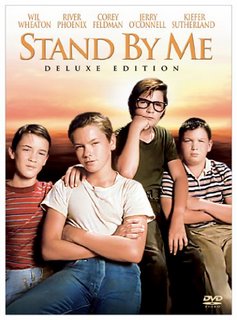
Growing Up With Stand By Me

These next two weeks we are using a film that doesn't have as obvious connctions to faith, but some profound thoughts on life and death, growing up, friendship, and making choices.

Stand By Me offers a view through the eyes of four twelve-year-old boys in 1959 rural America (filmed in Oregon). This movie uses a very literal “Journey” theme, as well as a brotherhood, and coming of age look at life. Throughout this film, the four boys deal with many issues--all of them are spurred by, and surround the idea of sneaking off to look at the body of another boy their age who was killed by a train. The boys set out, following the very same tracks that led to the other boy’s death, and find themselves in a whole new world as they learn much more about each other and themselves than they had ever imagined.

Throughout the movie we see train tracks and trains. What significance, if any, do these things play in the story? How might they be a metaphor for the journey that the four friends are on?

How do the four boys in Stand By Me display their innocence and what kinds of changes do you see them going through as the story goes on? In what ways do they grow up? How do they stay the same?

As the movie progresses, how does the boys perception of death change? Does their ability to face it and cope with it change or develop? How does this experience change their perception of the world and life in general?


Stand By Me has a lots of good stuff about growing up, life and death, innocence, and friendship packed into a relatively short movie. We hope that you'll take a look at some of these things and enjoy some coffee with us at the Blue Pepper. Please feel free to comment or pose more questions here as well!

Monday, February 13, 2006

Batman Begins With God

Summit the last two weeks have had some great conversations about God through the eyes of Batman. Specifically the movie Batman Begins.
In this film, Bruce Wayne constantly struggles with the fact that he has to give up his very identity to be able to serve his fellow man in need. He does this by assuming his alter ego (Batman) and fighting for the innocent people who cannot fight for themselves. He constantly grips at revenge and anger as his motivations for doing what he does, but as he has more experience being Batman and his identity as Bruce Wayne fades, he discovers that his desire for revenge is not what drives him, but something deeper.

How does the theme of temptation function through Batman Begins? What temptations does Bruce Wayne face? How does he defeat tempation and how does he lose?

How does Bruce Wayne/Batman's motivation to stop injustice change through the film? Consider the difference between justice and revenge throughout the movie. What role does compassion play in justice?

There are many more questions that came up during our conversations from this movie, such as Batman being a Christ figure, or even Bruce Wayne's father being the Christ figure, giving up his life for the very people who killed him. Please feel free to comment and leave more questions and have this place be a continuation or starting point for you in this conversation.

Wednesday, January 18, 2006

Indiana Jones and the Journey of Faith

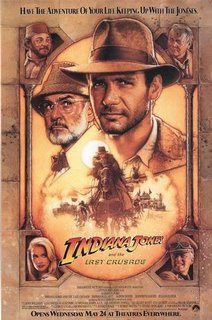
For Summit tonight we watched the first half of Indiana Jones and the Last Crusade. The discussion was great, and we want to use this blog as a place to continue the conversation, look deeper at the questions, find new questions and more insight into how God interacts with us and the journey we take in order to find and understand Him better.

Throughout the film Indiana struggles with the relationship between him and his father. Always trying to impress and appease him, he only finds his father not paying attention to him, busy with his own life and leaving Indiana with a feeling that his father is never really there (a feeling that most everyone has felt in his or her relationship with God at one time or another). How is Indiana's journey of faith shaped by his quest for his dad, and not trinkets? When Indiana and his father are sitting at the crossroads in the motorcycle debating over where to go, what does Jones Sr.'s urgency to go to Berlin to get his diary tell about what he believes?

Indiana also struggles with his faith. He is in the field of Archaeology, which looks for facts, evidence and historical items. Or in the words of Indiana Jones, "Archaeology is the search for fact... not truth. If it's truth you're looking for, Dr. Tyree's philosophy class is right down the hall." How does Indiana's faith change? What is Archaeology to Indiana and does it change as the film progresses?

Remember, use this as a place to ask more questions about the movie, God, faith or other things you think of. See you next week!

Monday, January 09, 2006

New Location...New Summit


Since the beginning of January, you have probably noticed that our Summit coffeehouse has been in extreme flux on a week-to-week basis. The past few weeks, however, have given us an excellent opportunity to "renovate" Summit so that it will continue to be a place where faith conversations can take place in a safe, comfortable atmosphere. What's changing?

Beginning Wednesday, January 18 Summit will have a new home. We'll be meeting in an upstairs room at the Blue Pepper (click here for a map and directions) from 7:00 to 9:00 p.m. The atmosphere is just right at the Blue Pepper (art gallery, internet cafe) not to mention the availability of a 42" plasma screen TV for Summit. We'll still have free coffee for anyone who wants to drop by, but we're also hoping to expand our "menu" with the availability of some good stuff from the Blue Pepper.

In addition to the location change, Summit will be focusing more on spiritual conversations around various movies...entire movies. Before January 18, we'll be working hard picking various movies that we can view in a month long series and use as good conversation starters.

Thanks for staying connected as we make some adjustments in the Summit line-up. Looking forward to seeing you on Wednesday, January 18 at the Blue Pepper.

~Dwayne

Monday, January 02, 2006

Goals, Journeys, Relationships, and new starts

Happy New Year to all of our readers!

With the new year comes all sorts of new starts, new relationships, new journeys, and new goals. Almost every person I know makes some sort of resolution for the new year ahead. Some are small things and others are, well, colossal undertakings. I once read somewhere that something like 85% of the U.S. population make resolutions for each new year. Of those 85%, almost all of the resolutions made were to do one of these three things: Lose weight. Stop (insert bad habit here). Save more money. The article also talked about how around 90% of the people who make said resolutions will not complete them, let alone make it one year. Some did not even make it one week.

I make resolutions. This year my resolutions are more personal goals I have set for myself. I am intent on making my goals. I have about one typed page of goals, and I am now in the process of organizing them, and making a plan for each. What are my goals you ask? First and foremost, to get back on the fat loss wagon. I fell off the fat loss wagon in late October. School and work got really crazy for me, so I just concentrated more on things that did not involve exercising and eating right. I also intend on maintaining a zero missed class record, and to achieve a 3.0 GPA this term. I want to be able to run in a half marathon by next September. I did not get my road trip last summer, so I am intent on going this year. Goal for that road trip? Hike into phantom ranch from the North Rim of the Grand Canyon. (I have already hiked to the bottom from the south Rim). I also intend on strengthening my relationship with God. Will I keep my resolutions and make my goals? I hope so, I am pretty set on them, and I am getting my friends involved in keeping me on track. Typing this right now has me wondering, what kinds of goals do you have? How do you make resolutions? (lip service, write them down, tell friends?) How do you maintain those goals?

Relationships and Journeys: This has been the focus of where we have been taking Summit for the past few months, and intend on keeping with that theme for a while, because each one alone can be pretty deep. Life is a series of relationships, as much as it is a series of journeys.

SUMMIT KICKS OFF AGAIN THIS WEDNESDAY! January 4th, 2006. This will be the first Summit of the new year, and we have a few new ideas and topics to share with all of you. As always... Free cookies and coffee. We hope that this site will become a forum of discussion about life, culture, God, and how they all intertwine! We look forward to your comments.

If you are a first time visitor, and/or you have come here because you found one of our website cards laying around, please take a minute or two to drop a comment.

~Eric

the opposite of faith...fear, not doubt

As I was planning some things for our Home Community tonight, I kept getting stuck on a particular passage in the Bible. We are reading through Mark together and will be asking questions about a story in Mark 9 where Jesus heals a boy possessed by an evil spirit. At one point, the boy's father says, "I do believe; help me overcome my unbelief!"

Since reading that, I've been thinking about faith all day. Somewhere along my thinking, I felt compelled to call my good friend Wilson (he always seems to make me ask more questions). He said, "The opposite of faith isn't doubt; it is fear. We always assume that it is so wrong to doubt or question God, but it's not. It's sad when our fear cripples our ability to believe."

You can see how that has only generated more questions. But, needless to say, it made me think a lot about Summit and the environment that is created every Wednesday. I like the fact that I can go to Summit honest about my doubts and questions. I enjoy the conversation and appreciate looking at things that are happening all around us in culture only to come away with more questions about God.

There are some lyrics written by singer/song-writer Chris Rice that say:
God if you're there, I hope you show it
And God if you're there, I need you to know that
I hope you don't mind me asking you questions
But I figure you're big enough
I figure you're big enough

Somehow, I gotta think that God's big enough to handle my questions and doubt

~Dwayne

Saturday, December 17, 2005

Through Christmas and the New Year

Thanks to everyone for coming and being open to asking questions and dialoguing. There won't be Summit at Spoons this next week, but we want to encourage more conversation online through the new year. We'll probably post a question or two to discuss, so feel free to post anytime and talk with each other. We'll come back in 2006 and keep the conversation going over a cup of coffee and a cookie. (Remember...it's free!)

This is probably the coolest thing about Summit, is that we don't need a place to do it. Summit is a "third place" at a coffee shop, online, or one on one, that we want to help create for people to come and join in the creation of a place that they can discuss God and related cultural topics, where people can be themselves and where there are no stupid questions.

Christmas time is upon us, which means we'll all be spending more time with our families and more money on gifts. Here are some questions: Why presents? Why buy stuff for people? Have you ever made a present for someone that they liked better than a store-bought one?

You might want to answer that question, or even another perhaps more important question: What do I need in my life? Think about it. What things are important enough to me that if I didn't have them in this life I probably wouldn't make it? Is it love? Is it a sports car? What about the comfort of owning my own house? Is it acceptance? An Xbox 360?

Remember, Summit isn't about answering these questions for you, it's about helping discover them together. Come with your answers, or come with more questions. We'll all be better off for it. And have a wonderful Christmas!

Monday, November 28, 2005

Hospitality & Open Mic Night

In a recent conversation that I had (ok, two weeks ago), the individual I was chatting with read the following quote from Henri Nouwen:

"Hospitality, therefore, means primarily the creation of a free space where the stranger can enter and become a friend instead of an enemy. Hospitality is not to change people, but to offer them a space where change can take place ... The paradox of hospitality is that it wants to create emptiness, not a fearful emptiness, but a friendly emptiness where strangers can enter and discover themselves as created free; free to sing their own songs, speak their own languages, dance their own dances ... Hospitality is not a subtle invitation to adopt the lifestyle of the host, but the gift of a chance for the guest to find his own."

Simple, but very powerful words. This coming Wednesday is Open Mic Night at Summit and I couldn't help but put these two things together...hospitality and Summit. We want Summit to be the kind of place where people can be themselves as we explore spirituality together.

If you or someone you know are interested in bringing some kind of talent to Open Mic Night (i.e., singing, painting, poetry...you name it), drop us an email and we'll look forward to letting you showcase those gifts. If you simply want to come and enjoy the atmosphere and a free cup of coffee, we have a seat open for you.

~Dwayne

Wednesday, November 09, 2005

what does the journey of faith look like?

Our apologies to those who have visited the Summit blog recently only to find nothing new under the sun. The past week has included some ironing out of Summit themes as well as figuring out how to generate a larger community of discussion on Wednesday nights.

With those in mind, we're hoping to continue and expand the recent dialogue we've had about approaching life and faith with the imagery of journey as a backdrop. Last week, we got a good laugh from a Will Ferrell SNL clip and enjoyed some action from the movie Shrek. In many ways, we gave everyone there a taste of what Summit was like and kept the spiritual questions pretty light.

This week, we want to look a little more closely at this idea of approaching God in the same way that one would approach a journey or quest. I'm sure that some old SNL scenes may pop up, but our featured art form is a few scenes from Lord of the Rings. What big decisions did Frodo make before starting his journey with the ring? What risks were involved? What big questions might have been at the forefront of his mind? Likewise, if following God is a journey of faith, what big decisions seem important before starting the journey? What risks are involved? What big questions do you have? What questions seem important to address before you begin the journey and which ones might be answered in the journey itself?

Yes, those are a lot of questions, but we've said from the beginning that Summit is a place where asking questions about God and culture is a good thing.

If you're looking for something to do tonight, drop on by Spoons from 7:00 to 9:00 p.m. and contribute to the conversation. We can promise a lot of questions and free coffee.